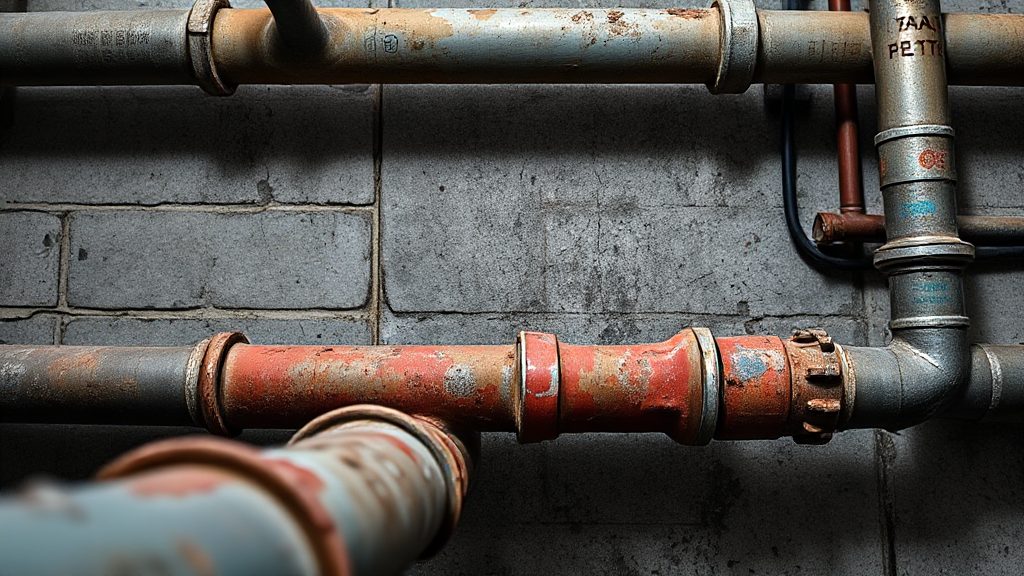
What Old Pipes in Casa Verde Buildings Are Made Of
Open the wall of a Casa Verde building from the 1970s and you will usually find two materials sharing the same drain line: cast iron in the vertical stacks and early PVC in the horizontal branches. That mix is not a curiosity. It explains a large share of the recurring clogs that residents in this part of São Paulo deal with year after year, and it changes how a desentupidora Freguesia do Ó team should approach each blockage.
If you are searching for a drain service in this neighborhood, the practical answer is simple: call a local team that works with both legacy metal and modern plastic piping, because the tool that clears one can damage the other. Below is a material-by-material look at what is actually inside these walls, how each pipe type fails, and what that means for repair decisions.
Why Casa Verde’s Pipe Mix Matters More Than Its Age
Buildings from the 1960s to the 1980s were constructed during a transition period in Brazilian plumbing. Cast iron was still the standard for soil stacks because it was strong and quiet, while PVC was becoming cheaper and easier to install for branch lines and fixtures. Many buildings ended up with both, joined at transition fittings that are now decades old.
That junction is where problems concentrate. Cast iron and PVC expand at different rates as water temperature changes, so the joint works loose over time. Once a transition fitting starts to weep, grease and soap residue catch on the rough edge and begin to narrow the pipe from the inside.
The material transition points are the weakest links in most older Casa Verde drain systems. A camera inspection that stops at the first straight run will miss them entirely.
Cast Iron: Strong, Quiet, and Quietly Corroding
Cast iron soil pipe was chosen for its durability and for how well it dampens the sound of water and waste moving through a stack. In a well-maintained building it can last fifty years or more. The problem is that “well-maintained” is doing a lot of work in that sentence.
How cast iron actually fails
Inside the pipe, hydrogen sulfide from waste combines with moisture and gradually attacks the metal, especially along the top of horizontal runs where gases collect. The result is graphitization: the iron softens and flakes while keeping its original shape, so the pipe looks intact from outside until it cracks or collapses.
From the drain’s point of view, the corroded surface is rough. Rough walls trap hair, grease and paper far more aggressively than smooth pipe, which is why a cast iron stack that was fine for thirty years suddenly seems to clog every few months.
What this means for clearing a clog
A rotating cutting tool used on a healthy PVC line is standard practice. Used inside a graphitized cast iron stack, the same tool can scrape away what little structural integrity remains. A cautious technician inspects first, then chooses a gentler method such as hydrojetting at controlled pressure. This is one reason residents search for a desentupidora Freguesia do Ó São Paulo SP that explicitly handles older metal piping rather than a general handyman with a drain snake.
Early PVC: Smooth Inside, Brittle Outside
The PVC used in 1970s and 1980s buildings is not the same formulation sold today. Older rigid PVC becomes brittle as plasticizers migrate out of the material over decades, and it is far less tolerant of movement and heat than modern pipe.
The hidden weakness at joints and bends
Solvent-welded joints from that era often develop hairline cracks at the shoulder of a bend, where stress concentrates. These cracks do not leak much at first, but they catch debris and create a slow buildup that feels like a recurring clog in one specific fixture.
Heat is the other enemy. Repeated doses of near-boiling water — a common home remedy for grease — can soften and deform older PVC, creating a sag where water pools and solids settle. If a kitchen line clogs every few months despite careful use, a sagging section is a strong suspect.
Why snaking can make things worse
A stiff auger forced through a brittle bend can crack it, turning a clearing job into a repair job. On old PVC, the safer path is usually a flexible cable or low-pressure jetting, followed by a camera check to confirm the pipe survived the process intact.
Galvanized Steel Supply Lines and Their Drain-Side Effects
Not every problem in an old building starts on the drain side. Many Casa Verde apartments still have galvanized steel supply piping, which corrodes from the inside and gradually narrows. Reduced flow means fixtures drain more slowly and waste sits in the trap longer, which accelerates buildup downstream.
Homeowners often blame the drain when the real issue is a choked supply line feeding a fixture. A proper diagnosis distinguishes between the two before anyone starts cutting into a wall. When a technician arrives from a desentupidora em Freguesia do Ó São Paulo SP, asking whether supply pressure has been checked is a fair and useful question.
Clay and Concrete in the Underground Runs
Below the building, the picture changes again. Older properties in the neighborhood often connect to clay or concrete sewer laterals, materials that are durable but unforgiving. Clay joints shift with soil movement, and tree roots find the gaps with remarkable efficiency.
Concrete laterals develop cracks and, over time, sections of the invert — the bottom curve that carries flow — can erode away, leaving a flat spot where solids accumulate. Root intrusion and settled sections are the two most common causes of a lateral that backs up repeatedly no matter how often it is cleared.
These underground runs are where camera inspection earns its cost. A short video of the lateral tells you whether the problem is a simple obstruction, a root mass, or a collapsed section that no amount of jetting will fix permanently.
Comparing the Materials Side by Side
The table below summarizes how each material behaves and what it means for maintenance decisions.
| Material | Typical location | Common failure | Clearing approach |
|---|---|---|---|
| Cast iron | Vertical stacks, older horizontals | Internal corrosion, rough walls | Inspect first; controlled hydrojetting |
| Early PVC | Branch lines, fixture connections | Brittle bends, cracked joints, sags | Flexible cable, low pressure |
| Galvanized steel | Supply piping | Internal scale, reduced flow | Supply-side diagnosis, not drain work |
| Clay | Underground lateral | Root intrusion at joints | Cutting head, then camera check |
| Concrete | Underground lateral | Cracks, eroded invert | Camera inspection; possible repair |
Material dictates method. The same clog in two buildings can require two completely different tools depending on what the pipe is made of.
What a Sensible Repair Decision Looks Like
When a clog recurs in an old Casa Verde building, the decision tree is shorter than it looks. First, confirm where the blockage actually is: fixture trap, branch line, stack, or lateral. Second, identify the material at that point. Third, choose the least aggressive method that will clear it.
If the same section clogs three times in a year, stop clearing and start inspecting. Repeated blockages in cast iron usually mean the pipe’s interior is finished, and patching around the problem only postpones a larger failure. In early PVC, a recurring clog at one bend often justifies replacing that short section rather than fighting it indefinitely.
For underground laterals, the camera decides the plan. Roots can be cut and monitored; a collapsed concrete section needs excavation or lining. Knowing which one you are dealing with prevents spending money on repeated clearing that will never solve the underlying issue.
None of this requires the homeowner to become a plumbing expert. It requires asking the right questions before work begins: what is this pipe made of, what did the camera show, and what is the plan if the clog returns? A local team that works in these older buildings every week will have straightforward answers, because the material mix described here is the everyday reality of the neighborhood.